
October 12, 2026
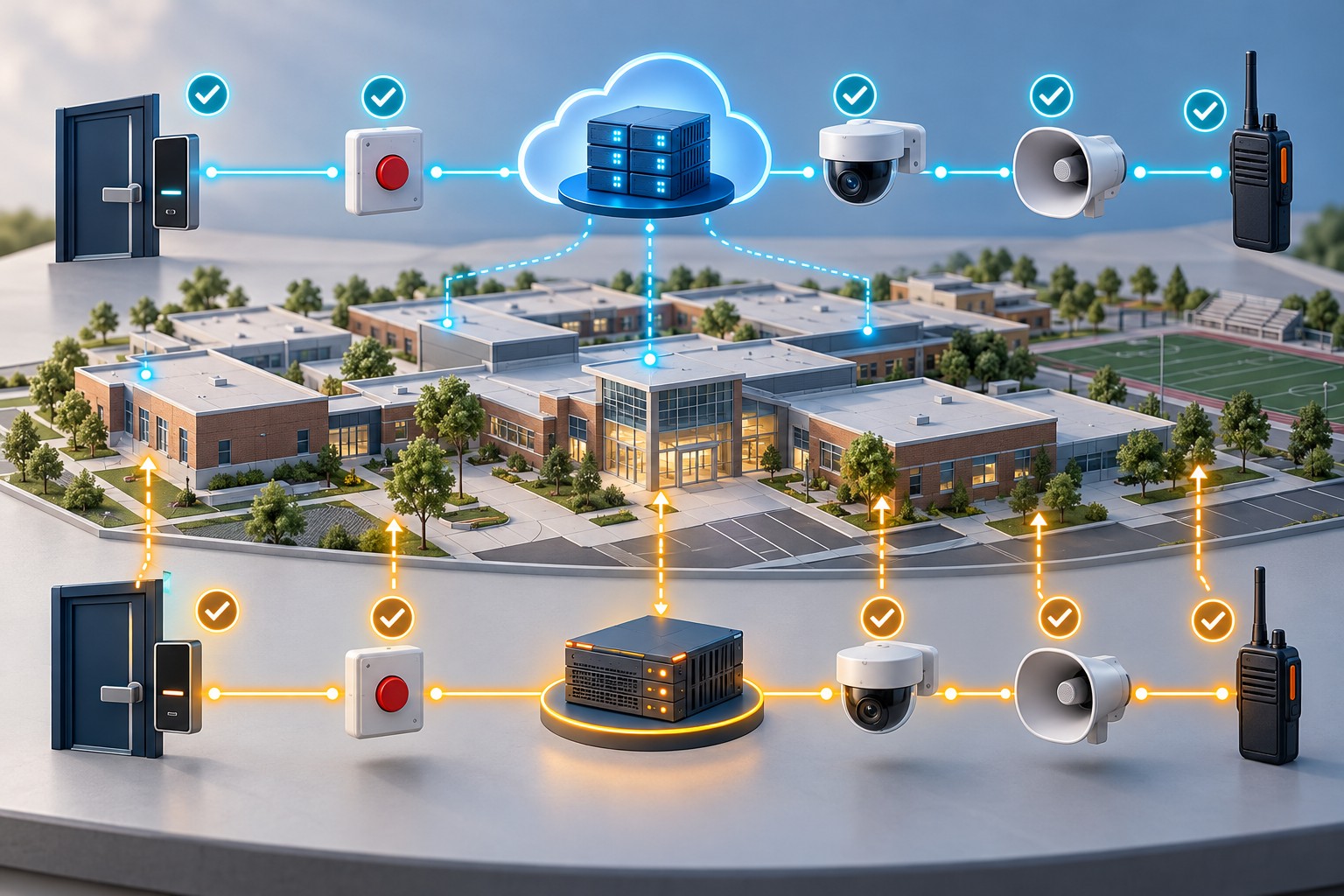
Gates, alerts, video and communications need verifiable paths when identity, network, cloud or power fail.
Summary
The U.S. Department of Education presents K-12 cybersecurity as part of emergency planning and links to a guide for creating a cyber annex. This guide calls for courses of action before, during and after an incident, with defined tasks, criteria and responsible parties.
For a school with access control, panic buttons, video, intercoms or connected notifications, the operational question is concrete: What function is available if a digital dependency fails? Answering it requires moving from a list of equipment to a map of functions, dependencies and proven alternatives.
Context
The REMS guide explains that a cyber incident can cross continuity of operations, communications and alerts, security and recovery. It also proposes integrating IT specialists, technology managers, administrators, security forces and other relevant actors into the planning team.
NIST SP 1800-36 provides a complementary technical reference for IoT: verifying identity and posture before delivering network credentials and managing the device during its lifecycle. The NISTIR 8259 series organizes technical capabilities and non-technical support that manufacturers can consider. None of these publications prescribe a school architecture or guarantee continuity of a specific product.
Implications for K12
1. Inventory features, not just devices
“Camera 14” or “north access reader” are not enough to plan continuity. The inventory should indicate the function they support: verify entry, release an output according to the code, initiate an alert, provide visual context or distribute instructions.
The same function can depend on several components; A single component can support several functions. That relationship allows us to detect single points of failure without assuming that all connected devices have the same risk.
2. Draw the complete chain
For each critical function it is advisable to record:
- local device and driver;
- normal power and backup;
- network segment and identity services;
- local server, cloud or provider link;
- operator application and communication channel;
- integrations that receive or transmit the event;
- support, updates and end of life.
The map should limit sensitive details by role. The operational goal is to understand dependencies, not to publish an attack guide.
3. Define observable states
A binary “online/offline” dashboard can hide partial failures. It is more useful to separate states such as available, degraded, isolated, unknown and recovering, with an observable test for each.
For example, connectivity with a camera does not demonstrate that the video reaches the authorized location, maintains correct time, and can be recovered. A sign of health is telemetry; an end-to-end test provides evidence.
4. Design the transition to gradient mode
Each critical unit needs an agreed response: local operation, radio, key or manual procedure, alternative channel, physical patrol, controlled closure or temporary suspension of a function. The alternative must respect life safety, accessibility, privacy and applicable code.
The plan must also say who declares the degraded mode, how personnel are informed, what actions are prohibited, and what conditions allow a return to normal mode.
5. Test bounded faults
A test does not need to take the entire campus offline. You can simulate or isolate a dependency in a controlled way: cloud loss, identity unavailable, segment without connectivity, backup power or operator application out of service.
The result should record scope, time, observers, expected function, actual behavior, deviation, residual risk, responsible person and date of remediation. Testing must be coordinated so as not to generate real alarms or compromise security.
6. Control registrations, changes and withdrawals IoT
Trusted NIST onboarding highlights device identity, credentials, and posture. In a school operation, that means not connecting devices with shared credentials or uncertain provenance, logging approved settings, controlling updates, and removing access when a device goes out of service.
The life cycle includes the supplier. Contracts and purchases may require a support window, vulnerability notification, log export, continuity in the event of service interruption, and a secure deregistration process.
7. Measure resilience without promising invulnerability
Useful metrics include percentage of critical features with documented dependencies, approved alternatives, last end-to-end test, time to detection, time to degraded mode, open exceptions, and age of remediation.
No metric demonstrates that a campus is “safe.” They serve to manage preparation and reveal operational debt.
##How is it related to Clipxu
Editorial positioning
Clipxu can model each function, its dependencies, responsible parties and alternative routes; receive integration statuses; guide transition checklists; and retain evidence of testing and remediation. The original source of each event and the difference between telemetry, proof and human confirmation must remain visible.
Automation should not change a door, dispatch a response, or declare a system recovered just because of an AI inference. AI can summarize results or detect dependencies without recent testing, but an authorized manager must review the recommendation and execute the applicable procedure.
Checklist for a critical function
- Name the function and the expected security result.
- Identify device, energy, network, identity, cloud and operator.
- Mark sensitive data and minimum necessary access.
- Define normal, degraded, isolated and recovery states.
- Agree on a local or manual alternative and its limits.
- Assign authority to activate and close degraded mode.
- Test the chain end-to-end without creating an actual alarm.
- Record deviations, residual risk and remediation.
- Review support, credentials, updates and end of life.
- Repeat the test after relevant changes.
Sources
-U.S. Department of Education — “K-12 Cybersecurity” —https://www.ed.gov/teaching-and-administration/safe-learning-environments/school-safety-and-security/k-12-cybersecurity— publication date not visible; Content consulted includes “National Cybersecurity Awareness Month 2026”; consulted on 2026-10-12. -U.S. Department of Education, REMS TA Center — “Cybersecurity for K-12 Schools and School Districts: Developing a Cyber Annex” —https://www.ed.gov/media/document/rems-k-12-schools-and-school-districts-developing-cyber-annex-fact-sheet-508c-2023-113278.pdf— published in 2023 (day and month not visible in the document consulted); consulted on 2026-10-12.
- National Institute of Standards and Technology — “NIST SP 1800-36: Trusted Internet of Things (IoT) Device Network-Layer Onboarding and Lifecycle Management” —https://csrc.nist.gov/pubs/sp/1800/36/final— published 2025-11; consulted on 2026-10-12.
- National Institute of Standards and Technology — “NISTIR 8259 Series” —https://www.nist.gov/itl/applied-cybersecurity/nist-cybersecurity-iot-program/nistir-8259-series— includes NISTIR 8259 Revision 1 published on 2026-04-09; consulted on 2026-10-12.