
June 16, 2026
The FY 2026 School Safety Enhancement federal competition will open up $93 million for state school security systems. The novelty isn't just the amount: the official priorities put together secure entry, visitor screening, communications, plans and exercises within a single phase of implementation.
Summary
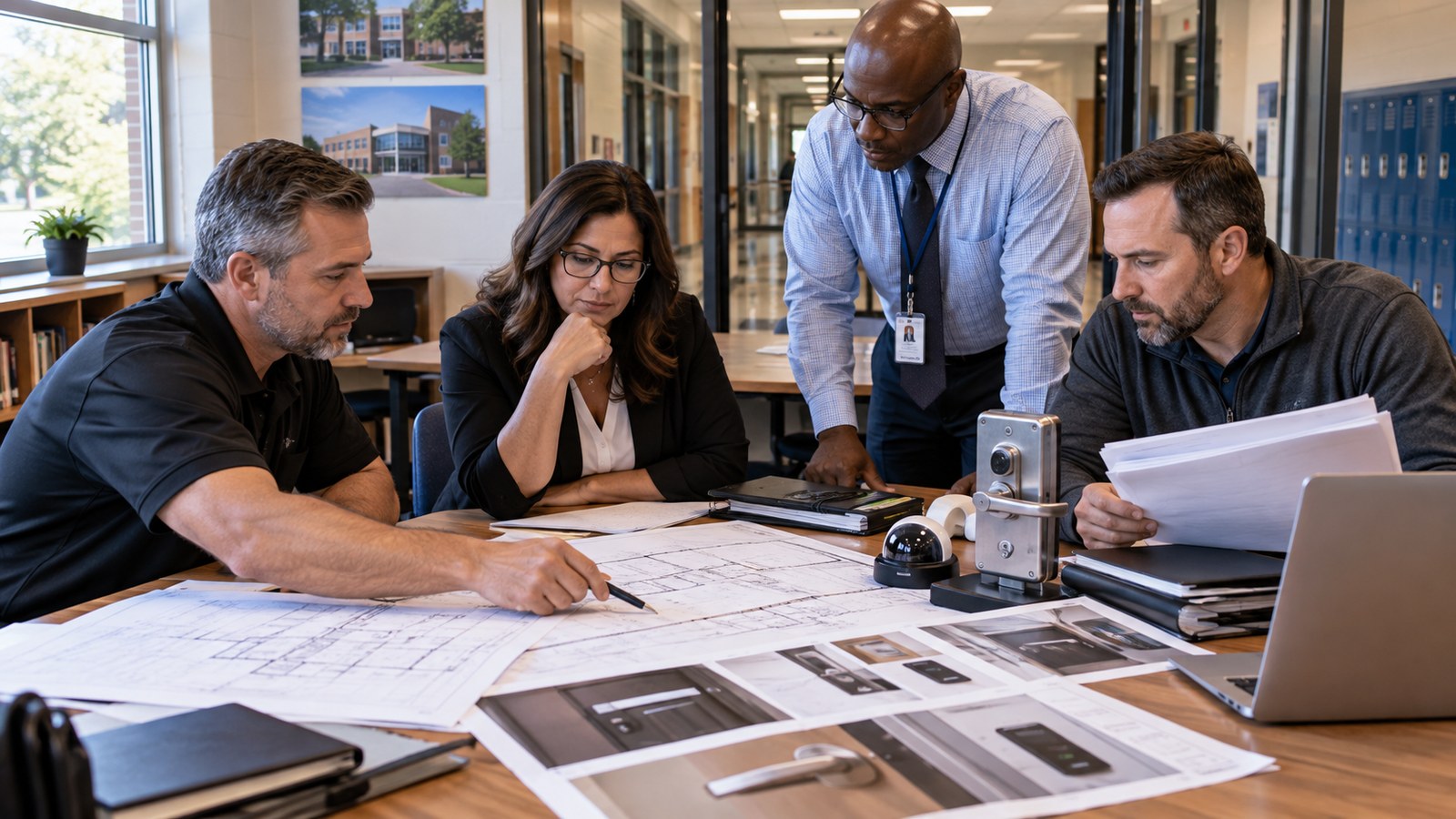
verified facts: The federal government opened competition FY 2026 School Safety Enhancement (SSE) for state educational agencies with $93,000,000 estimated, up to 30 awards and date of application on July 28, 2026 at 11: 59 p.m. ET . The official page and program instructions say that the goal is to strengthen statewide school safety systems and physical security of schools . The eligible priorities include: inside door locks , secure entry systems , metal detectors or security cameras , perimeter controls , visitor screening infrastructure , emergency communication systems , update of response plans and preparatory exercises.
Interpretation: The SSE's strong senal isn't just budgetary. The federal program arms an operational taxonomy where access, visitors, video, communication and response plans are financed as parts of the same architecture.
Context
Facts (according to sources)
- The official notice was published in Federal Register June 3, 2026 .
- The program's instructions were posted on 27 May 2026 .
- They can only apply State Educational Agencies (SEas) , one by state.
- The program allows the SEA to give subgrants to LEas or directly manage.
- The notice links competition with findings from the DOJ report about Robb Elementary and emphasizes co-ordination with law enforcement and emergency responses.
What should not be inferred
The sources do not guarantee that each district receives funds or that visitor scanning or video analytics are required by themselves. What they do show is that federal design prioritizes these capabilities within the financial menu.
Implications for K-12
- Visitor management goes into the hard language of financing : no longer just as local reception or compliance.
- Physical security and response are integrated : locks, inputs, communications and exercises appear as a same stop.
- The states gain weight as orchestrators : Security architecture can come down by SEA and not just by district.
- The K-12 market should read the complete senal : the program awards integration and planning, not a list of loose gadgets.
How it relates to Clipxu
Facts (about Clipxu): Clipxu works with convergence between location, access, signage and operational co-ordination.
Editorial Positioning (propose): using the SSE to explain why the value proposal should talk about layer orchestration : visitor scanning, access, communication and shared context for response, not just an isolated module of hardware or software.
Sources
- U.S. Department of Education - "School Safety Enhancement Program (84.184A)": https://www.ed.gov/grants-and-programs/grants-birth-grade-12/safe-and-supportive-schools/school-safety-enhancement-program-84184a - advertised call 2026-05-27 , consulted 2026-06-16 .
- U.S. Department of Education / HHS - PDF "Application Notice and Instructions, FY 2026 School Safety Enhancement Program": https://www.ed.gov/media/document/application-notice-and-instructions-fy-2026-school-safety-enhancement-program-84184a-may-27-2026-114127.pdf - published 2026-05-27 , consulted 2026-06-16 .
- Federal Register - "Notice Announcing School Safety Enhancement Program Competition": https://www.federalregister.gov/documents/2026/06/03/2026-11103/notice-announcing-school-safety-enhancement-program-competition - published 2026-06-03 , consulted 2026-06-16 .