
June 8, 2026
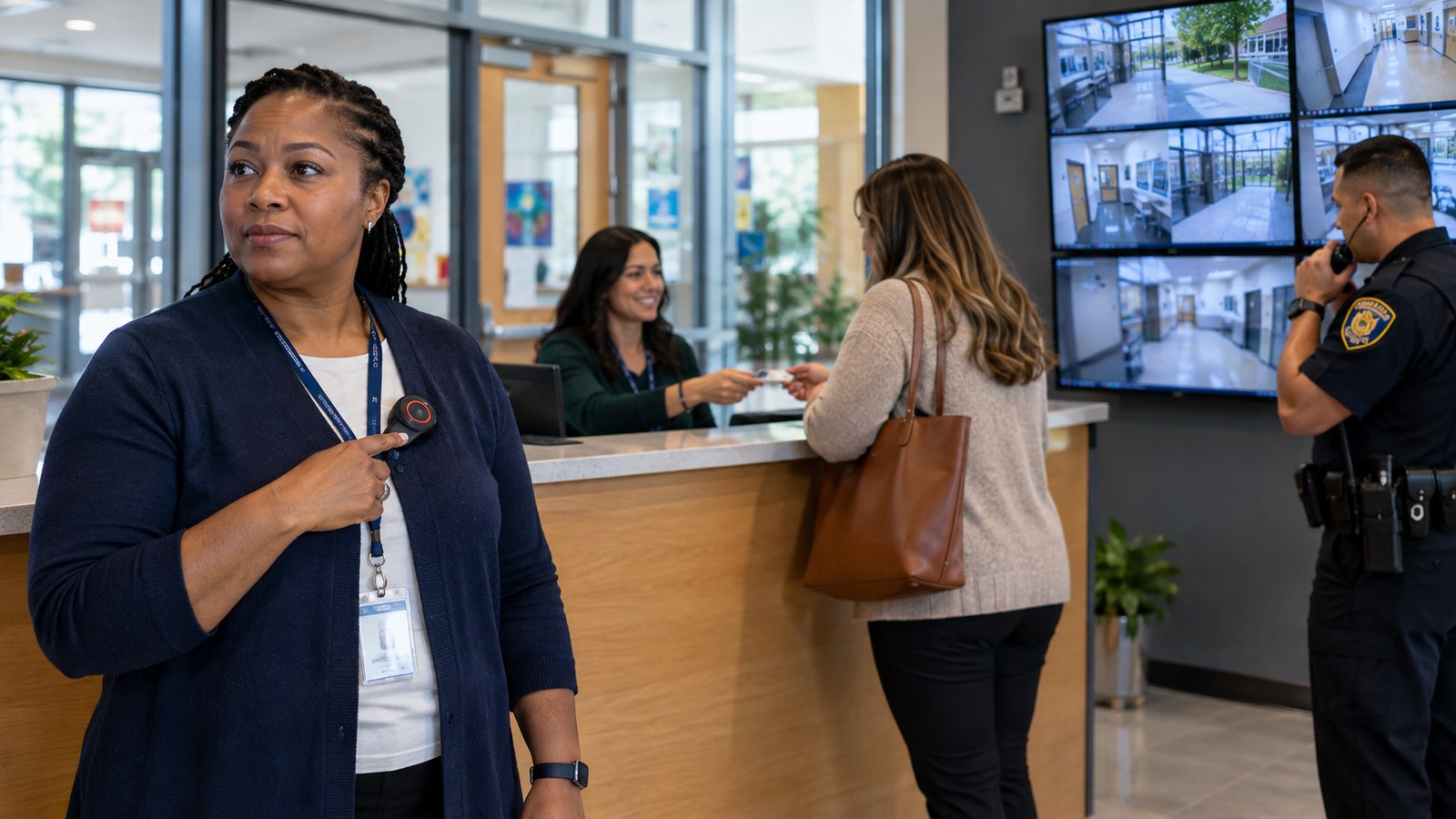
With effect from 6 May 2026, Utah does not treat panics as an isolated product. The text connects panic alerts directly to PSAP, access to cameras, key boxes, training and visitor management. For K-12, the message is clear: response and access monitoring are already a single operative layer.
Summary
verified facts: The Utah code, with effect from 6 May 2026 , requires that LEA provide usable panic alert devices that directly communicate with public safety advertising points (PSAP) to lead teachers in each classroom and, from 1 July 2027 to some security personnel. The same text commands annual training prior to class start, access to security cameras for law enforcement and PSAP, co-ordination of access protocols, physical marking of corridors / doors and use of universal access key boxes . In parallel, the school safety needs assessment should evaluate visitor management protocols and its alignment with better practices. The official legislative report adds that LEA should implement visitor management systems and meet minimum cyber security standards.
Interpretation: Utah isn't buying loose pieces. It's defining a minor operational architecture where panic, video, keys, access control, first responders and visitor management are treated as parts of the same school system.
Context
Facts (according to sources)
- The demand for panic alerts is attached to PSAP, not just internal notifications.
- The law connects hardware with maintenance and protocol: training, co-ordination with responders, accesses and infrastructure upgrade.
- Visitor management appears inside the needs assessment, leading from reception to security planning.
precautionary point
The legal sources describe obligations and structure but do not yet prove the quality of performance in each district. The operational risk remains in partial or without data governance.
Implications for K-12
- Panic bottle without context no longer reach : the value is to link alert, location, access and response.
- Video and accesses come into the formal response : if PSAP and response forces have to have access to cameras or keys, authentication, maintenance and audit have to be defined.
- Visitor management ceases to be reception : becomes an evaluable security capacity.
- Cyber security's already part of the package : The legislative report links these physical layers with minist standards and shortcuts report.
How it relates to Clipxu
Acts (about Clipxu): Clipxu seeks to orchestrate senals and operational context.
Editorial Positioning (propose): Utah offers a solid base to explain why Clipxu should be read as a layer of response orchestration , but not as an isolated module. The value is to correlate alert, location, status of access, visual evidence and protocol.
Sources
- Utah Legislature — Utah Code 53G-8-805 "Panic alert device -- Security cameras -- Key box": https://le.utah.gov/xcode/Title53G/Chapter8/53G-8-S805.html - efectivo 2026-05-06, consultado 2026-06-08.
- Utah Legislature — Utah Code 53G-8-701.5 "School safety needs assessment": https://le.utah.gov/xcode/Title53G/Chapter8/53G-8-S701.5.html - efectivo 2026-05-06; version futura visible 2026-07-01, consultado 2026-06-08.
- Utah State Board of Education — "2026 Legislative Summary": https://schools.utah.gov/policy/_policy_/_utahlegislativesession_/_2026_/LegislativeSummary_2026-Print1.pdf - publicado 2026-05 (segun el documento), consultado 2026-06-08.