
August 24, 2026
The standardized term isn't just training: panic buttons, access control, PA, apps and office should preserve the same meaning and policy version.
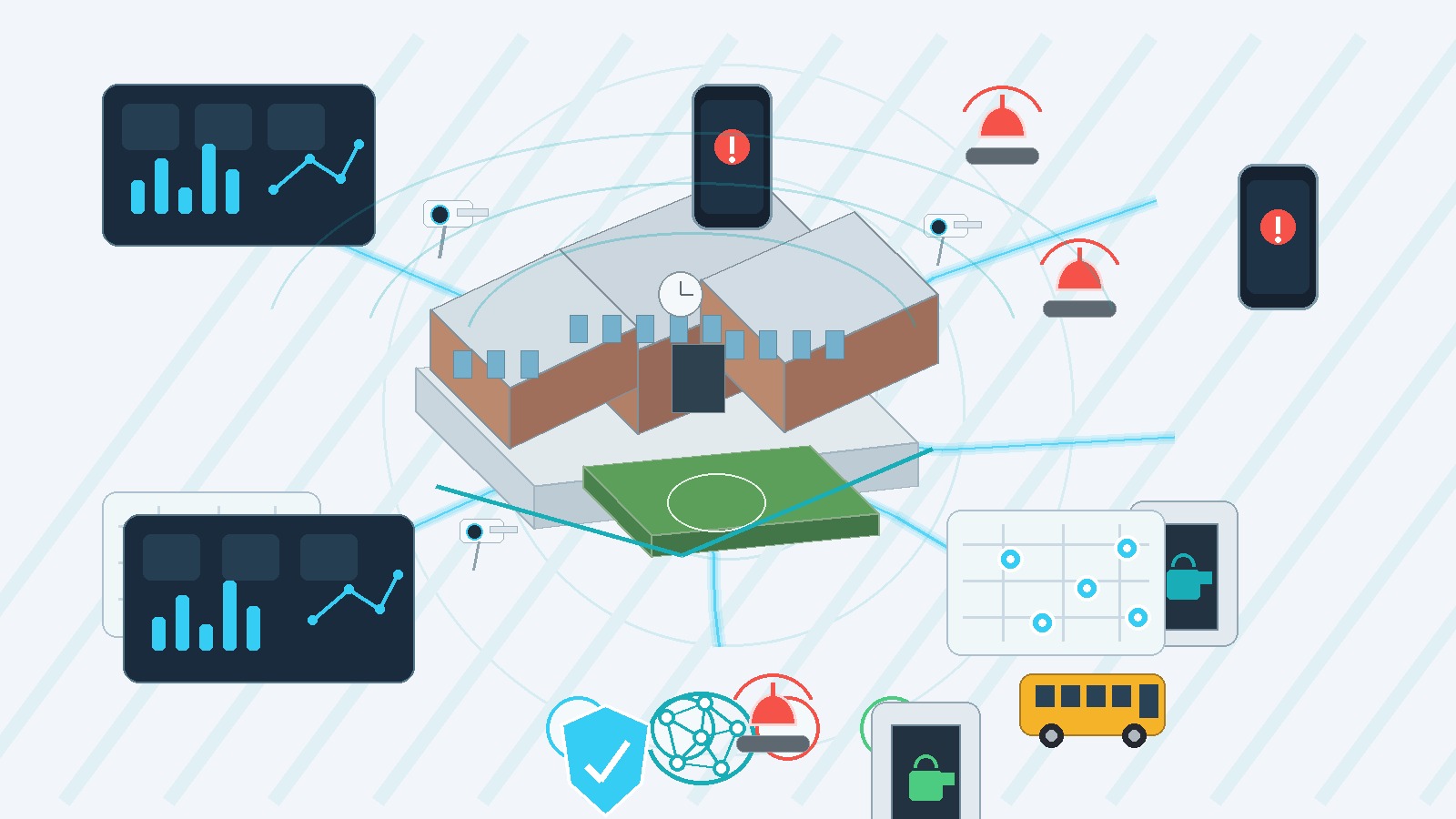
Summary
verified facts: Michigan State police report that Public Acts 270 and 271 of 2024 established a standardized response terminology and its adoption from 2026-27 cycle by public, non-public and local law enforcement schools with respect to specific situations. The state page, updated on August 7, also warns that the proposed rules are still under JCAR review prior to their final presentation and publication.
Interpretation: a common vocabulary only improves the response if it retains the same meaning while travelling between people and systems. The label that a teacher sees, the code that emits a panic button, the monitoring action, the PA message, the dyspatcher's view and the incident's registration should not depend on improvised translations.
Context
What established Michigan
- The legislation commissioned to Michigan State Police, together with the School Safety and Mental Health Commission, develop standardized terminology, including a color system.
- The adoption from 2026-27 corresponds to public and non-public schools and the state site also includes local law enforcement agencies in their use in some situations.
- The public state training resources, FAQ, reference of a page and a card with five actions.
- The administrative approval was not closed at 7 August: JCAR revised the proposed rules and the Secretary of State had to publish them after their end.
What the source doesn't prove
The page does not certify integrations, does not set technical latences, does not require an IoT platform and does not prove that color by itself prevents errors. Nor does it allow a proposed version to be frozen as if already final.
Implications for K-12
Treat terminology as ruled data
Each official activity can be represented by a versioned object, but as free text:
- stable event or action identifier
- The label and colour currently in place for the jurisdiction;
- operational definition and conditions of initiation
- actions permitted or required by role and system
- accessibility channels, languages and adaptation;
- an authority that can modify or close the state;
- version and effective date of policy.
Thus, a regulatory update can change the presentation or workflow without losing the historic traceability of earlier incidents.
Separate sign, meaning and action
A device generates a sign : push, forced door, video rule or call. The institution assigns an meaning after validating context. Then actions are authorized: notify, block, evacuate, open a path, scale or request confirmation.
That separation reduces two risks. First, an automatic alert activates a disproportionate response without verification. Second, that two systems interpret differently the same word or color. The AI or video analytics can give evidence and priority, but you shouldn't quietly rewrite the official taxonomy.
Test end to end translation
A interoperability exercise can check:
- that the term and its version are maintained from source to each recipient;
- That visual interfaces, audio messages and accessible notifications are equivalent;
- that the systems record confirmations, exceptions and partial faults;
- that "all clear" or closure requires the intended authority;
- That a policy shift does not alter historic incidents or leave equipment with incompatible boards.
The useful indicator isn't just "message delivered." It also matters how many manual translations have happened, how many endpoints have been using an outdated version and how soon every role I have to confirm the right meaning.
How this relates to Clipxu
Facts about range: Clipxu can orchestrate events, rules, states and traces between security and operations components.
Proposed editorial positioning: to have a weekly record as part of the flat control. Each Connector can map native signals to a common event and receive actions consistent with the current policy. The dashboard can display source, confidence, official term, version, authority, recipients and exceptions without concealing the original sign.
Clipxu should not unilaterally define the term of Michigan, assume that the proposal under review is immutable and automate human decisions that politics reserves for authorized personnel. His contribution is to make his meaning configurable, consistent, observable and auditable.
Sources
- Michigan State Police, Office of School Safety - "Standardised Response Terminology" - https://www.michigan.gov/msp/divisions/grantscommunityservices/school-safety/standardized-response-terminology - updated on 2026-08-07 and consulted on 2026-08-24 .
- Michigan State police, Office of School Safety - main and notice "Standardised Response Terminology - August 7, 2026 Update" - https://www.michigan.gov/msp/divisions/grantscommunityservices/school-safety - updated on 2026-08-07 and consulted on 2026-08-24 .
Trust and limits
- High for general mandate, start cycle and status of administrative flow: official state source.
- Medium-high for the exact scope of each term: the page links resources but the proposed rules could still change before their final publication.
- Media for the signalling model -significado-action and the versionado registration: an editorial and technical proposal, and no textual requirement of Michigan.
- That article was not a legal advice or a guarantee of compliance, interoperability or effectiveness.