
June 1, 2026
ED connects cyber security with emergency operations planning and recommends immediate actions. The Brief "Defensive & Resilient" translates this idea into operational practices (hygiene, KEV, scanning, regional contacts).
Summary
Controlled events (according to sources): The U.S. Department of Education (ED) presents K-12 cyber security as an operational issue: describes that districts face an average of five cyber incidents per week and explicitly links cyber security with emergency operations planning . ED recommends low-cost immediate actions (keeping up-to-date software / patching, MFA, strong passwords and phishing report) and targets report channels (CISA and FBI). Also, ED indicates that the K-12 Cybersecurity Government Coordinating Council (GCC) was established at Spring 2024 and was paused at Spring 2025 while evaluating "next steps."
In parallel, the document " K-12 Digital Infrastructure Brief: Defensive & Resilient (Version 1.0) " (ED / OET, 2023) includes useful CISA practices and resources for K-12, such as using the Cross-Sector Cybersecurity Performance Goals (CPGs) to prioritize, service recommendation as Cyber Hygiene Vulnerability Scanning , using the catalogue Known Exploited Vulneralities (KEFI) and regional support (CISA) and responding to regional challenges.
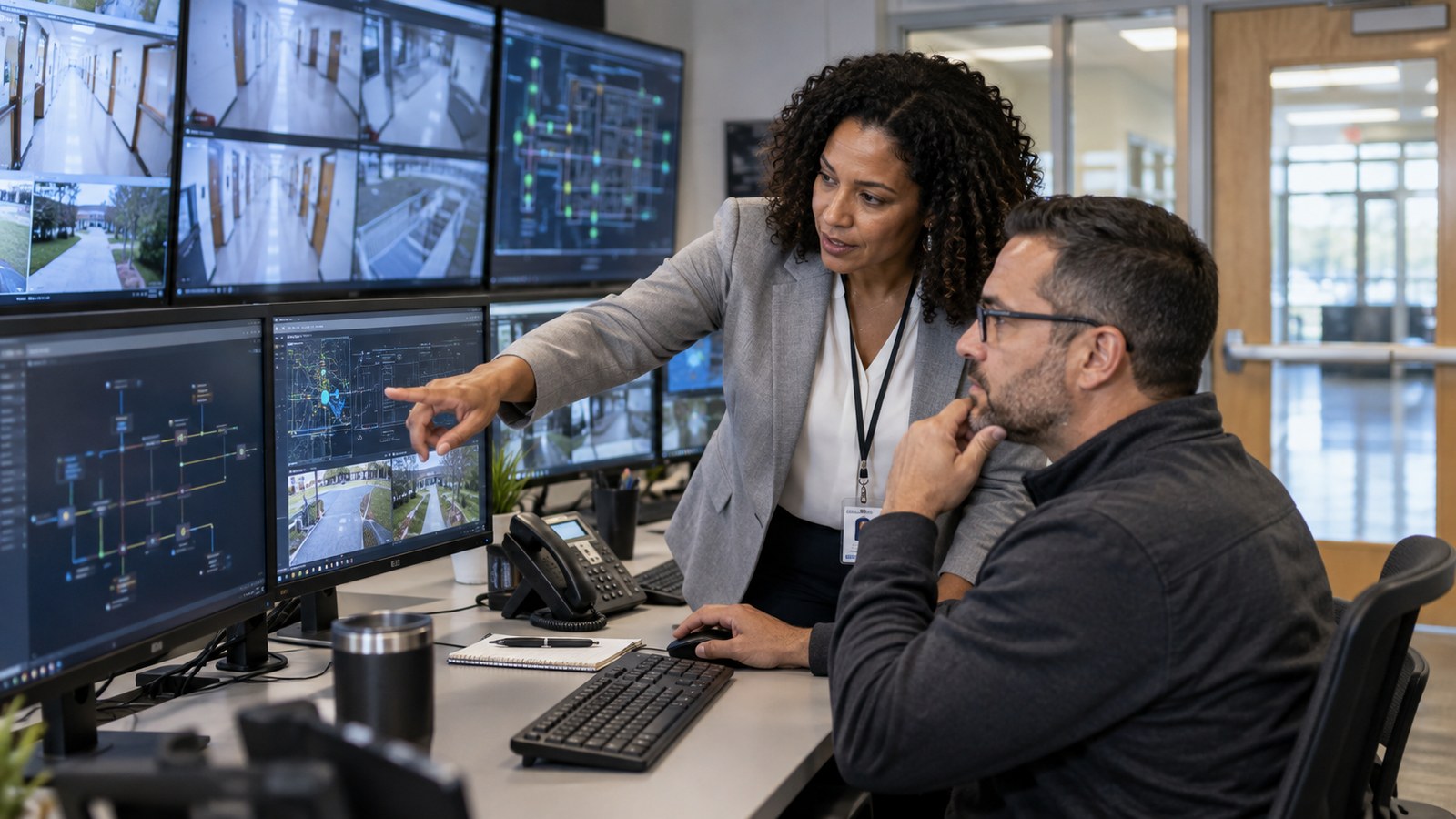
Interpretation: "School security" can no longer be modeled as two separate worlds (physical vs. digital). Physical security systems (access monitoring, video, intercom, panic buttons, mapping) depend on credentials, firmware, networks and cloud services. In 2026, the question became: how "defensible and resilient" was the complete stop under crisis conditions?
Context
Signs from the ED guide
- ED sets cyber security as a prerequisite to sustain daily operations (educational service and management) and to strengthen incident response capacity.
- ED highlights "Core 4" actions (patching, MFA, passwords, report phishing) and guides MS-ISAC / K12SIX for information exchange.
Signs from the Brief "Defensive & Resilient"
- The Brief propose prioritizing NIST CSF aligned practices with CPGs (2022, update 2023).
- It recommends that you enlist with vulnerability scans and review / mitigate what appears as actively exploited (KEV) and subscribe to alerts.
Implications for K-12
Operating checklist (in purchase and operation language)
- cyber-physical inventory : treat "video / accesses / panic" as IT assets (versions, firmware, credentials, vendors, contracts).
- Continuity : defining what goes with cloud outages and connectivity and establishing fallback procedures in incidents.
- Segmentation and minimum privileges : separate networks for IoT / physical safety; paper credentials; trackability of changes.
- Parches and KEV : To integrate patching checks into internal and supplier SLA audits and prioritize exploited vulnerabilities.
- Report and Coordination : turn "who I call" (CISA / regional FBI) into a procedure and exercise as part of EOP.
Typical risk
Installing security technology without an update discipline, credentials and monitoring produces "black boxes" that miss at bad times or increase attack surface.
How this relates to Clipxu
Facts (about Clipxu): Clipxu integrates signals to support response and operation flows.
Editorial Positioning (proposed): Clipxu as a cape that connects cyber-physical signals with procedures and evidence: who fired an event, what context was attached, what actions were run and what metrics are left for continuous improvement.
Sources
- U.S. Department of Education — “K‑12 Cybersecurity”: https://www.ed.gov/teaching-and-administration/safe-learning-environments/school-safety-and-security/k-12-cybersecurity - sin fecha visible en la página, consultado 2026-06-01.
- U.S. Department of Education — “K‑12 Cybersecurity Government Coordinating Council (GCC)”: https://www.ed.gov/teaching-and-administration/safe-learning-environments/school-safety-and-security/k-12-cybersecurity/k-12-cybersecurity-government-coordinating-council-gcc - sin fecha visible, consultado 2026-06-01.
- U.S. Department of Education (OET) — “K‑12 Digital Infrastructure Brief: Defensible & Resilient (Version 1.0, 2023)”: https://www.govinfo.gov/content/pkg/GOVPUB-ED-PURL-gpo229257/pdf/GOVPUB-ED-PURL-gpo229257.pdf - publicado 2023-08 (según el documento), consultado 2026-06-01.