
September 7, 2026
The student badge can connect transport, meals, library and events without turning every reading into universal access and continuous monitoring.
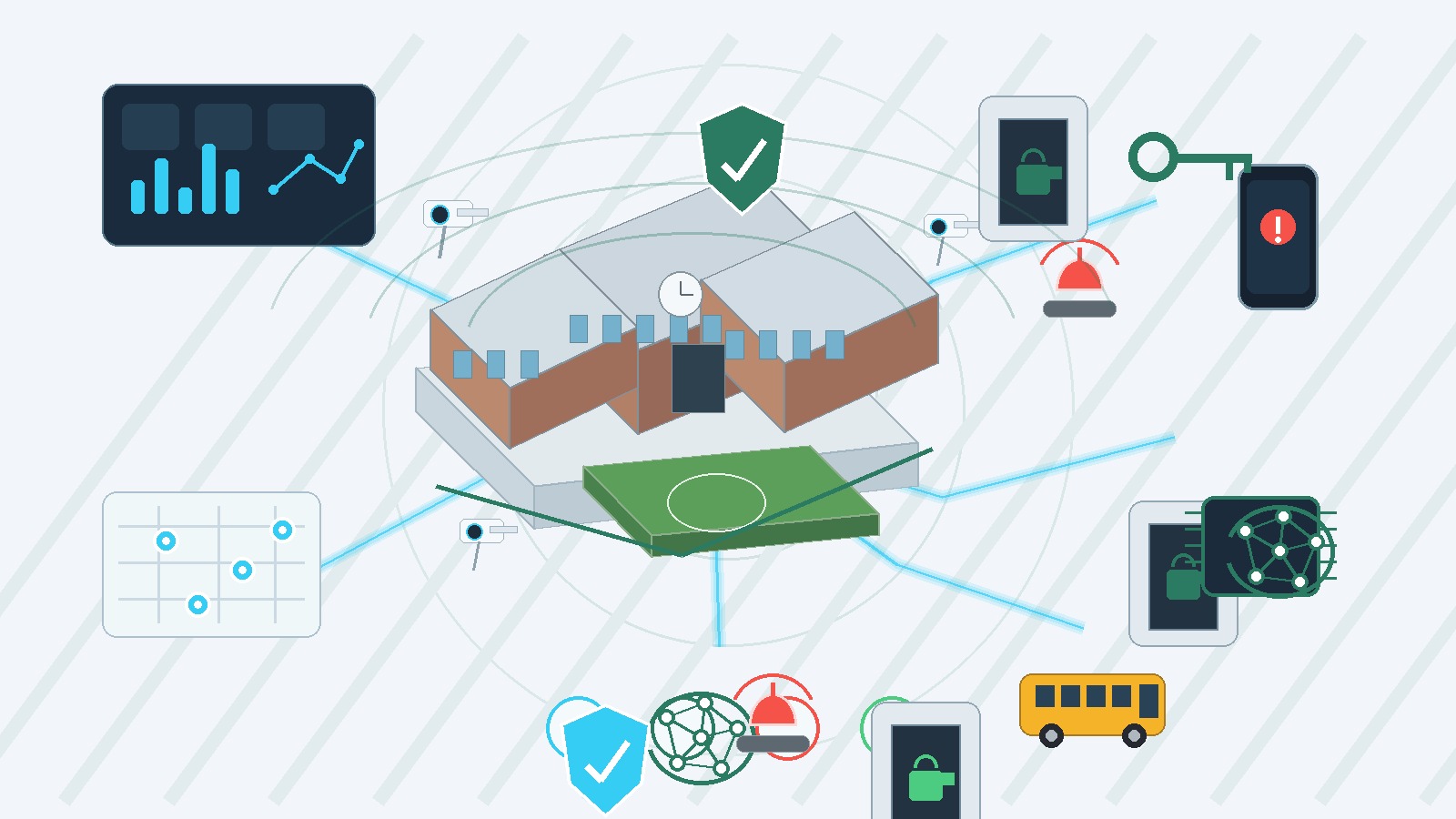
Summary
Round Rock ISD starts cycle 2026-27 with a common student credential for visual identification and different digital activities: transport, food, library and some facilities during events. The important sign isn't the plastic but the consolidation of several operative contexts into the same support.
Consolidation should not mean universal permission. A secure architecture can use a common identifier while keeping the capabilities, data, those responsible and duration of each authorization separate.
Context
On September 4, 2026, the Security Bulletin of Round Rock Id. I remember that students at all levels would use One Badge and that credential was used to board the bus. A previous report from the District indicates that grades 6-12 have to have been visible and that in primary schools, teachers manage their credentials and Smart Tags are still in their backpacks for transport. The district also lists food, library and access to select event facilities.
Those have been declared by the District. The publications consulted do not describe whether each function shares database, radio technology, identifier, supplier or retention policy. They also report biometrics, continuous geolocalisation and an independent evaluation of results. No such characteristic should be assumed.
Implications for K-12
1. Modeling capabilities, not an omnipotent identity
The same physical support can have a photo and transport an identifier, but each consumer system should only solve its question:
- Visual identification: does the person seem to be matching to the credential?
- Transportation: Can you board this and stop at this time?
- Meals: Can you register this transaction without displaying its itinerary?
- Biblioteca: Can you withdraw this material as per current policy?
- A select event or door: does a temporary authorization exist for this point?
The response of a domain should not open the others. "Can use the library" doesn't mean "can come through any door," and "aboard the bus" doesn't mean a confirmed presence in a classroom.
2. Design the life cycle before the reader
Daily safety depends on low-light states: emitted, delivered, activated, suspended, lost, replaced, defeated and returned. For each passage it's best to define who can run it, how long it takes to spread and what happens if a reader's offline.
A replaced credential should invalidate the earlier one without erasing legitimate traceability. A temporary exception should be achieved by itself. If the central system does not respond, the campus needs close rules of continuity that do not transform a defect into unrestricted access.
3. Avoid comfort from creating a complete timeline
When a credential plays bus, cafeteria, library and event, the records can rebuild an extensive part of the day. That that correlation is technically possible doesn't mean that it's necessary for every role.
The minimization practice separates warehouses and permits, limits fields, lays down retention periods for purposes and registers sensitive consultations. The exceptional correlations have to be responded to an authorized and documented aim, and they have to be put at a standstill.
4. Prove regular abuses and malfunctions
Exercises don't have to start with an extreme threat. Cases such as binge loaned, wrong backpack, still up-and-up, low-end student, network-free reader or massive row at an event reveal if integration preserves low pressure boundaries.
Utile metallics include cancellation time, percentage of synchronized readers, manual exceptions, redacted refused accesses, active duplicates and consultations outside the expected role. No secluded metal shows safety, but together they show where the control is degraded.
How this relates to Clipxu
Editorial Position
Clipxu can integrate identity and access events with clear and clear capabilities, but with a universal student's tab. An event should preserve goal, system of origin, instant, point, decision, applied rule and responsible actor with references rather than unnecessary copies of personal data.
Automation can detect inconsistent states - for example, a replaced credential that remains active in a subsystem - and demand review. He should have no intention, an automatic sanction or an exact location if his evidence only attests to a punctual reading.
Editorial checklist for an implementation
- To inventory every capacity linked to the bad and its manager.
- To define the minimum data that each system receives.
- Document emision, lost, replacement, suspension and low.
- Separate permanent, time and exceptional authorisations.
- Test offline operation and later reconciliation.
- To conduct correlations between domains and administrative accesses.
- Communicate with families and students that they prove - and that they don't - every reading.
Sources
- Round Rock ISD - "2026 School Safety Newsletter" - https://www.roundrockisd.org/article/3113358 - published on 2026-09-04 and consulted on 2026-09-07 .
- Round Rock Isd - "Round Rock Isd Input One Badge" - https://earlycollege.roundrockisd.org/o/earlycollege/article/3042372 - published on 2026-07-24 and consulted on 2026-09-07 .