
June 1, 2026
SIA confirms that Transparency Mode remains open for implementation and promotes OSDP Secure Channel 2 (AES-256GCM). For schools, the sign isn't "more features": it's predictable interoperability and verifiable security at the entrance layer.
Summary
The Security Industry Association (SIA) reported in 2026-03-18 that the configuration OSDP Transparent Mode remains open to industry as a whole after confirming that related patents (as defined by the OSDP specification) will have no restriction on its implementation. SIA describes Transparent Mode as a capacity that allows using secure communication channels while transport specific data from applications between devices, enabling advanced functionality without losing interoperability and safety benefits.
In a synthesis of an SIA webinar (published 2026-04-02 ), the technical subcommission of OSDP introduces OSDP Secure Channel 2 with security improvements mentioned as AES-256GCM and strengthens the focus on consistent implementation , reduced ambiguity and predictability between devices to strengthen safety and interoperability.
Interpretation At K-12, the relevant novelity isn't "another protocol." It's a concrete path to reduce dependence on proprietary integrations and to demand, in purchases, a clear and auditable cyber-access layer, compatible with integrations (panic, video, mapping, analytics) without sacrificing control.
Context
Why it matters now (2026)
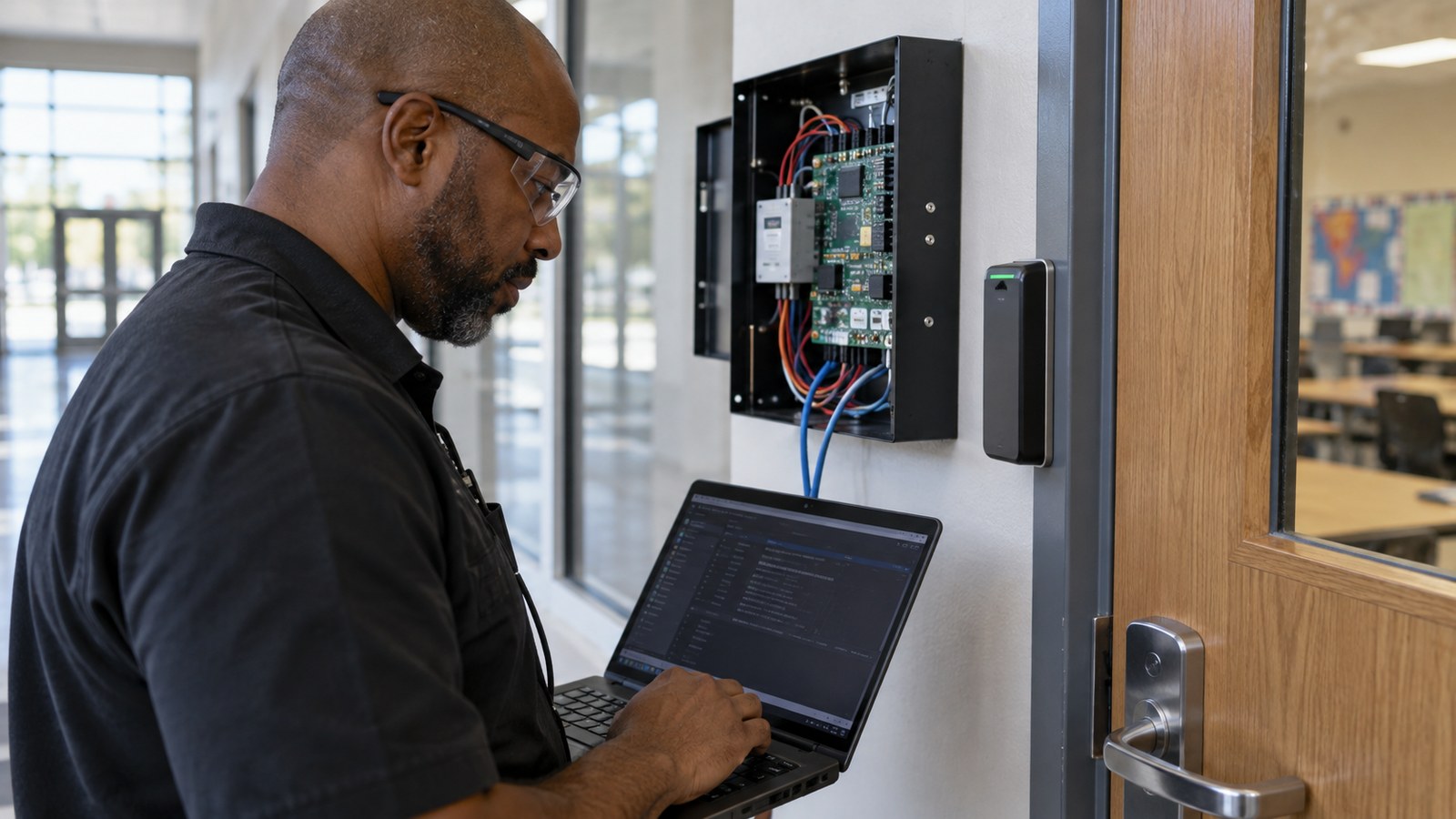
School security programs are turning into connected systems. That leads readers, controllers and credentials to be treated as cyber-physical infrastructure: if the entrance layer is fragile or ambiguous, the rest (alerts, monitoring, response) becomes noisy or insecure.
What Transparent Mode enabling (in practical terms)
If a district needs to transport "own" data (for example, metadata for advanced device functions), Transparent Mode aims to do so without breaking secure channel and base interoperability.
Implications for K-12
Procurement and operation recommendations
- require OSDP and secure channel as a basic criterion for access monitoring renovations (and migration plan with valid protocols today).
- To demand conformity tests and predictability: avoid deployments where "OSDP works half" as a combination of candor / firmware.
- govern keys / credentials and login : who sets up, who breaks up, what evidence remains (changes, faults, events).
- minimum feasible integration : prioritise integrations that reduce verification time (alert + location + door status + context) about isolated features. (5)) Security by default : Input into RFP explicit patches, segmentation and life cycle requirements.
Typical risk
Adopt "standards" without applying consistency production unpredictable results under pressure (for example, status or event sharing faults) and open space to proprietary "patch" solutions.
How this relates to Clipxu
Facts (about Clipxu): Clipxu integrates signals to support response and operation flows.
Editorial Positioning (propose): Clipxu as consumer / access sign normalizer: When the OSDP layer is secure and consistent, Clipxu can correlate door events / credentials with alerts, video and mapping and hold evidence and operation metrics.
Sources
- Security Industry Association — “Security Industry Association Confirms Openness of Transparent Mode for OSDP Standard”: https://www.securityindustry.org/2026/03/18/security-industry-association-confirms-openness-of-transparent-mode-for-osdp-standard/ - publicado 2026-03-18, consultado 2026-06-01.
- Security Industry Association — “The State of Industry Standards in 2026: Highlights From SIA’s Webinar”: https://www.securityindustry.org/2026/04/02/the-state-of-industry-standards-highlights-from-sias-webinar-2026/ - publicado 2026-04-02, consultado 2026-06-01.