
September 28, 2026
A confident response activates protections without waiting for certainty and verifies the threat without turning incomplete signals into facts.
Summary
An anonymous threat places a school in the face of a difficult tension: acting quickly even if the information is incomplete, without allowing a possible hoax to dictate the entire response. The joint letter GEN-26-04, published on September 25, 2026 by the United States departments of Education and Justice, calls for treating threats as credible upon receipt, protecting the community first, and continuing to evaluate whether it is swatting or a real threat.
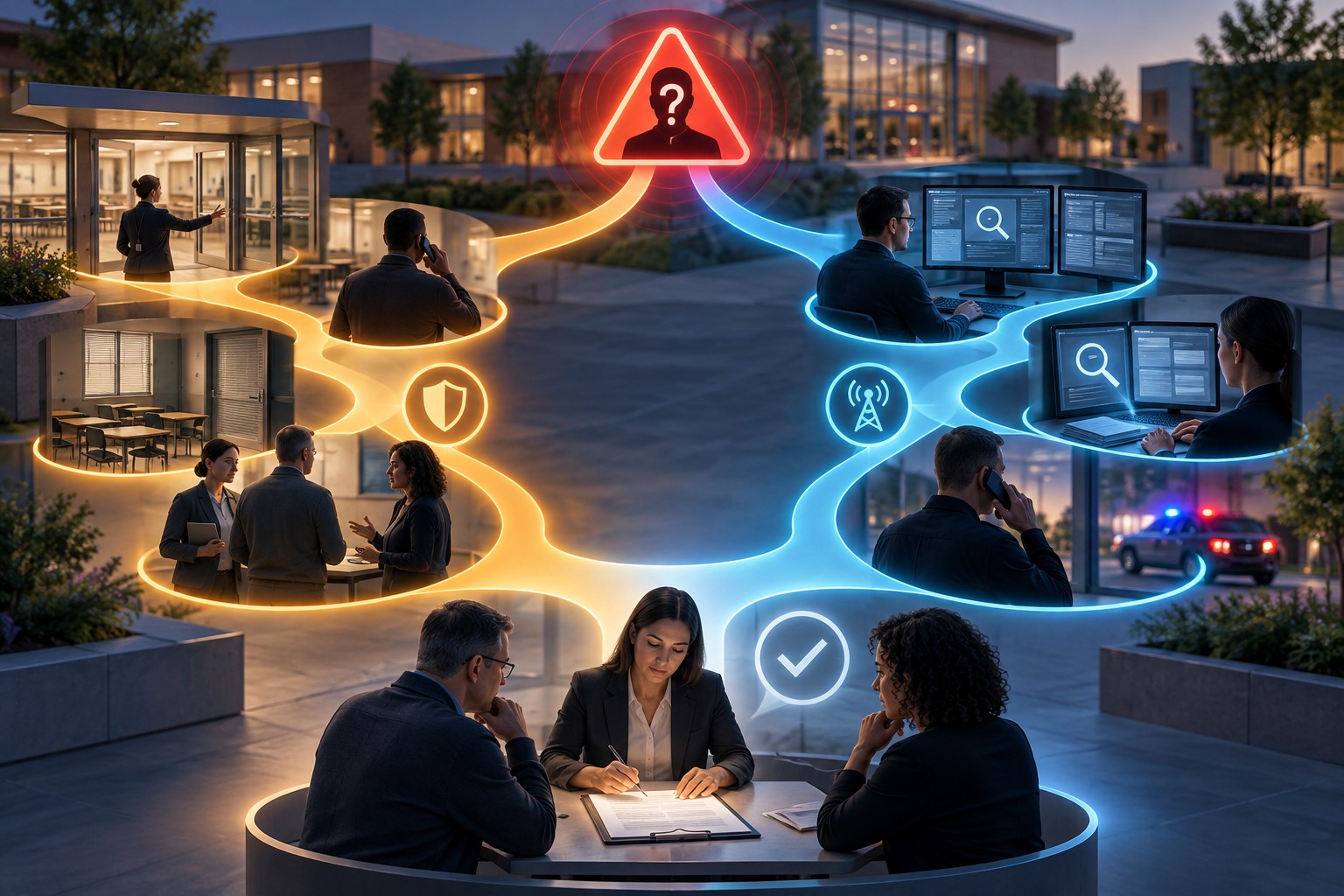
The response does not need to choose between “act” or “verify.” It can operate on two synchronized lanes: one runs pre-authorized protections; the other preserves evidence, seeks context and coordinates the evaluation with authorities. The technology must keep both flows connected without merging an uncertain signal with a conclusion.
Context
ED and DOJ describe swatting as a deception intended to provoke a police or emergency response against a person or organization. The attacker can resort to caller ID spoofing, social engineering, social networks, calls or emails to hide their identity or pretend that the notice comes from the victim.
The guide recommends establishing relationships and lines of communication between campus officials, security and external authorities; form multidisciplinary teams; perform table exercises; designate those responsible for communications, notification and evaluation; and prepare messages that share only the necessary information. It also warns that controls to recognize deception should not lead to ruling out a real threat.
The FBI Dallas had reported on August 24 that different agencies investigated numerous false threats and cases of swatting against schools during the 2025-2026 cycle. That communication is institutional context, not an audited national statistic or evidence of a specific current threat.
Implications for K12
1. Separate verification protection
The protection lane executes actions defined by the local plan: notifications, zone control, shelter-in-place, evacuation or other measures decided by authorized officials. The verification lane preserves the original communication, records provenance and available metadata, looks for corroborating signals, and maintains contact with authorities.
The two lanes share an identifier, a timeline and a person responsible for coordination. They do not automatically share all data: whoever sends messages to families may need the operational status, but not sensitive details of an investigation.
2. Use states that do not exaggerate certainty
A minimum flow can distinguish:
- Received: There is a communication that requires a response.
- Protection activated: planned measures were initiated, without affirming veracity.
- In joint evaluation: school and authorities compare information.
- Corroborated: there are independent signals compatible with a real threat.
- Not corroborated: there is still not enough confirmation; does not equal false.
- Determined as deception: the competent authority reached that conclusion.
- Closed and reviewed: decisions, impact and improvements were documented.
The distinction between “uncorroborated” and “false” prevents the initial absence of evidence from becoming a premature conclusion.
3. Control messages and rumors
The federal recommendation “Report, Don't Repost” reduces the amplification of screenshots, audios or unverified statements. Each institutional message should indicate time, authorized sender, requested action and time of the next part. Templates should avoid tactical details, unconfirmed identities, and language that presents inferences as facts.
A single source of status helps maintain consistency between SMS, email, app, web, telephony and internal communications. That does not guarantee delivery: each channel needs confirmation, redundancy and alternatives for families with language, connectivity or accessibility barriers.
4. Preserve evidence without hindering the response
The registry must preserve the original communication and its transformations: transcription, translation, automated classification, forwarding and priority changes. Each derivative needs time, author or system, version and link to the original. Staff should not destructively edit evidence to “clean it up” before sharing it with an authorized team.
Retention, access and delivery to authorities depend on applicable policy and law. The platform must allow controlled export and document who accessed or shared each element.
5. Limit the role of AI
AI can support reversible tasks: transcribing a call, detecting duplicates, comparing campus names, or summarizing information for review. It should not declare a threat false, attribute authorship, infer intent, or initiate a high-impact response on its own.
All automated output must show what an inference is, its source, and its version. A generated summary should never replace the original audio, message or evidence.
6. Rehearse uncertainty and concurrence
A useful tabletop exercise doesn't immediately reveal whether the scenario is real or fake. It introduces contradictory signals, duplicate messages, a downed channel, a campus with a similar name and rumors on networks. The goal is to check if the equipment can protect, verify, communicate and preserve evidence at the same time.
Metrics may include time to first authorized action, time to sustained emergency contact, conflicting messages, uncovered recipients, improper access to evidence, and delay in correcting public information.
##How is it related to Clipxu
Editorial positioning
Clipxu can act as an orchestration layer between alert channels, access control, directories, campus managers and emergency services. Their role is not to decide the truth of a threat, but to maintain coordinated actions and evidence while authorized people make decisions.
The platform should offer a common incident identifier, two separate views for protection and verification, least privilege roles, audience templates, delivery confirmation, immutable log and evidence export. Automations must be reversible and limited by local policy.
Editorial checklist for the double lane
- Define who activates protection measures and who coordinates the evaluation.
- Agree on continuous channels with authorities before the incident.
- Differentiate threats received, uncorroborated, corroborated and determined as deception.
- Link each action and message to a time, person responsible and source.
- Retain originals and record transcripts, translations, and AI summaries as derivatives.
- Prepare messages by audience and avoid tactical details or unconfirmed identities.
- Test for channel failures, duplicates, ambiguous campus names, and mixed signals.
- Measure coordination times and quality of decisions, not just quantity of alerts.
- Apply permits, retention and export according to purpose and jurisdiction.
- Review the incident with authorities and convert findings into verifiable changes.
Sources
-U.S. Department of Education and U.S. Department of Justice - “Guidance to Educational Institutions on Swatting Threats” (GEN-26-04) -https://fsapartners.ed.gov/knowledge-center/library/dear-colleague-letters/2026-09-25/guidance-educational-institutions-swatting-threats- published 2026-09-25; consulted on 2026-09-28.
- Federal Bureau of Investigation, Dallas Field Office - “FBI Dallas Brings Awareness to North Texas Parents of Swatting Risks and Provides Guidance for Talking to Children” -https://www.fbi.gov/contact-us/field-offices/dallas/news/fbi-dallas-brings-awareness-to-north-texas-parents-of-swatting-risks-and-provides-guidance-for-talking-to-children- published 2026-08-24; consulted on 2026-09-28.
- Cybersecurity and Infrastructure Security Agency - “Anonymized Threat Response Guidance: A Toolkit for K-12 Schools” -https://www.cisa.gov/sites/default/files/2024-10/ATRGToolkit508_V2.pdf- published on 2024-10 (day not visible in the source consulted); consulted on 2026-09-28.