
OSDP, Open Supervised Device Protocol, is a communication protocol for access control that improves supervision, interoperability, and security compared with legacy schemes.
What it means
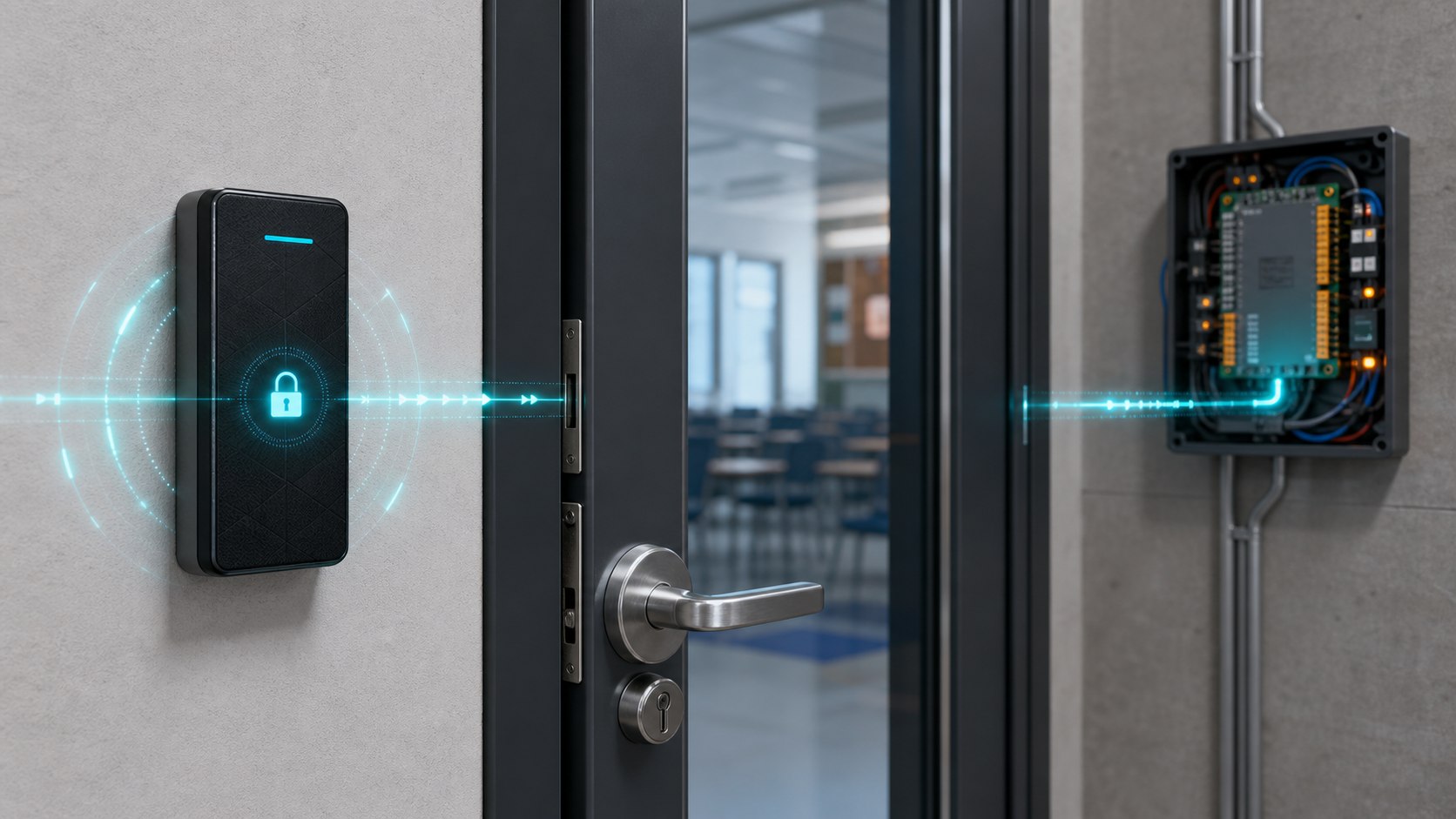
OSDP means Open Supervised Device Protocol. It is a standard promoted by the Security Industry Association for communication between access control panels and peripheral devices such as credential readers. It is used as a modern alternative to legacy connections such as Wiegand.
Its main contribution is bidirectional communication, device supervision, and, when correctly configured, Secure Channel with AES-128 encryption. This helps detect failures, tampering, or disconnection and reduces the risk of credential data being copied or intercepted through cabling.
Why it appears in schools
School access control is no longer limited to opening a door. In a K12 campus, a door can be part of a lockdown, evacuation, visitor, schedule, sports event, or alert-response workflow. If readers and controllers do not communicate securely and under supervision, automation may depend on a weak layer.
OSDP is especially relevant when a school modernizes entrances, credentials, interior doors, restricted zones, or integration with Policy Manager.
Operational benefits
- State supervision between reader and controller.
- Encrypted Secure Channel for protecting credentials and commands.
- Bidirectional communication for LEDs, sounds, messages, or configuration.
- Better interoperability among compatible manufacturers.
- A stronger base for audit and maintenance.
Points of care
OSDP does not guarantee security by itself. Secure Channel must be enabled, keys must be managed properly, cabling and topology must be correct, firmware must be compatible, and installation processes should not leave readers in an insecure mode.
It is also important to review real compatibility among the reader manufacturer, panel, access control software, and integration platform.
Reference sources
- Security Industry Association, Open Supervised Device Protocol: https://www.securityindustry.org/industry-standards/open-supervised-device-protocol/